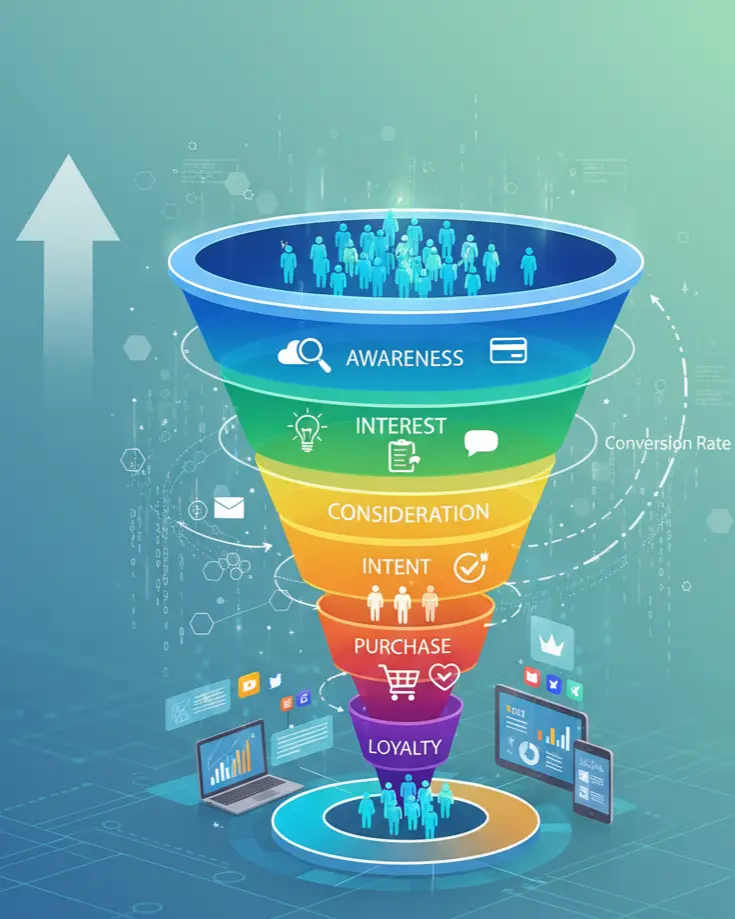
What is a Marketing Funnel
What is a Marketing Funnel A Marketing Funnel is more than just a notion; it’s a strategic structure that helps firms analyze, guide, and improve the customer experience. The concept is that at the top of the funnel (TOFU), you have a large audience, many of whom are unaware that they have an issue that your product or service can help them with. As they progress through the funnel, they get more engaged and qualified, until a smaller group reaches the bottom (BOFU) and transforms into paying customers. Stages of Marketing Funnel Awareness (Top of the Funnel – TOFU) Goal: Let people know your brand, product, or service exists. What happens: Potential customers first hear about you. Tactics: Social media posts, blog articles, SEO, paid ads, PR campaigns. Metrics: Website visits, ad impressions, social reach. Interest Goal: Capture attention and engage prospects. What happens: People start learning more about your offerings and consider them relevant. Tactics: Email newsletters, videos, webinars, engaging content. Metrics: Click-through rates, content downloads, newsletter subscriptions. Consideration (Middle of Funnel – MOFU) Goal: Help prospects evaluate your product or service. What happens: They compare options and research solutions. Tactics: Case studies, demos, free trials, product comparisons. Metrics: Demo requests, trial signups, product page views. Intent Goal: Encourage the prospect to take action toward purchase. What happens: They show clear interest, like adding items to a cart or requesting a quote. Tactics: Retargeting ads, personalized offers, and limited-time discounts. Metrics: Cart additions, pricing page clicks, inquiry forms submitted. Purchase (Bottom of Funnel – BOFU) Goal: Convert prospects into paying customers. What happens: They complete the purchase. Tactics: Smooth checkout, multiple payment options, sales support. Metrics: Sales, conversion rates, revenue. Loyalty / Advocacy (Post-Purchase) Goal: Turn customers into repeat buyers and brand advocates. What happens: They may buy again and recommend your brand to others. Tactics: Loyalty programs, follow-ups, referral incentives, and excellent customer service. Metrics: Repeat purchase rate, Net Promoter Score (NPS), referrals, customer lifetime value (CLV). Top of the Funnel – Explained The Top of the Funnel (TOFU) is the first stage of the marketing funnel, and its primary purpose is to raise awareness of your brand, product, or service. At this stage, potential clients are still learning about you and might not even be aware that they have a problem that your company can help with. Consider TOFU as a broad net. Reaching as many people as possible and introducing your business in a way that attracts interest and piques their curiosity is the goal. At this point, increasing visibility, trust, and interest is more important than selling. Key Activities at TOFU: Content marketing (blogs, infographics, videos) Social media campaigns and posts Search engine optimization (SEO) Paid advertisements (Google Ads, social media ads) Public relations, events, and webinars Objectives: Make your brand known to a broad audience Educate potential customers about industry problems or opportunities Start engaging people in a non-salesy way Metrics to Track: Website traffic Social media reach and engagement Ad impressions and clicks Number of new visitors or leads Middle of Funnel – Explained The Middle of the Funnel (MOFU) is the point at which potential clients have advanced beyond awareness and are thinking about your product or service as a solution to their requirements. Unlike the Top of the Funnel (TOFU), MOFU focuses on nurturing leads, establishing trust, and guiding them to a conclusion. At this stage, your audience is assessing options, analyzing competitors, and searching for proof that your solution can solve their issue efficiently. During this “consideration” stage, your marketing campaigns should try to inform, show value, and establish your brand as the greatest option. Key Activities at MOFU: Product demonstrations or walkthroughs Case studies showcasing success stories Free trials or sample offers Webinars and educational guides Email campaigns targeting engaged leads Objectives: Build trust and credibility with potential customers Highlight the unique benefits and value of your solution Move leads closer to a purchase decision Metrics to Track: Number of demo requests or trial sign-ups Downloads of guides, eBooks, or whitepapers Engagement with emails and targeted content Time spent on product/service pages Bottom of the Funnel – Explained The Bottom of the Funnel (BOFU) is the marketing funnel’s last step, when potential customers are ready to make a purchase. They are currently weighing the last few aspects before deciding to use your product or service, having already passed through the awareness (TOFU) and deliberation (MOFU) phases. The main goal of BOFU is conversion. Your marketing and sales efforts are centered on reducing any remaining barriers, reinforcing value, and making it simple for prospects to purchase. This step frequently includes personalized communication and direct engagement to create a smooth purchasing experience. Key Activities at BOFU: Product demos tailored to the prospect’s needs Personalized offers, discounts, or promotions Consultations or one-on-one sales calls Testimonials, reviews, and case studies emphasizing results Simplified checkout or onboarding processes Objectives: Convert leads into paying customers Provide reassurance and remove friction in the buying process Strengthen confidence in choosing your brand over competitors Metrics to Track: Conversion rate (leads to customers) Number of completed purchases or subscriptions Average order value Sales cycle length and success rate How to Develop a Marketing Strategy A marketing strategy is a strategic plan for reaching your target audience, promoting your products or services, and meeting business objectives. Here is a thorough, step-by-step tutorial: Step 1: Define Your Business Goals Understand what you want to achieve with your marketing efforts. Goals should be specific, measurable, achievable, relevant, and time-bound (SMART). Step 2: Identify Your Target Audience Know who your ideal customers are. Create buyer personas including demographics, interests, challenges, behaviors, and motivations. Understand where your audience spends time online/offline and how they make purchasing decisions. Step 3: Analyze the Market and Competitors Conduct a market analysis to understand industry trends, opportunities, and threats. Perform a competitive analysis to identify what competitors are doing, their strengths, and weaknesses. This helps you find your unique selling proposition (USP)
What is a Marketing Funnel Read More »